How is chronic pain treated?
Chronic pain treatment rests on a tripod with 3 inseparable legs: medications (chemistry), interventional techniques (physical) and mind-body therapies (mental). No single tool is enough — it is their combination that makes the therapeutic strategy stable and effective. This strategy, stemming from the therapist's perspective, is co-built with the patient around a shared goal: this is what we call the therapeutic toolbox.
1 — Why a tripod and not a single tool?
While acute pain is a symptom (a sensation) that regularly resolves with treatment of its cause, chronic pain is a disease (suffering) with many determinants, both physical and psychological. Pain itself is a personal experience of incredible complexity — it is therefore logical that treatment should approach this complexity.
Multimodal treatment thus relies on a tripod that forms the foundation of the therapeutic strategy: medications, interventional techniques, mind-body therapies.
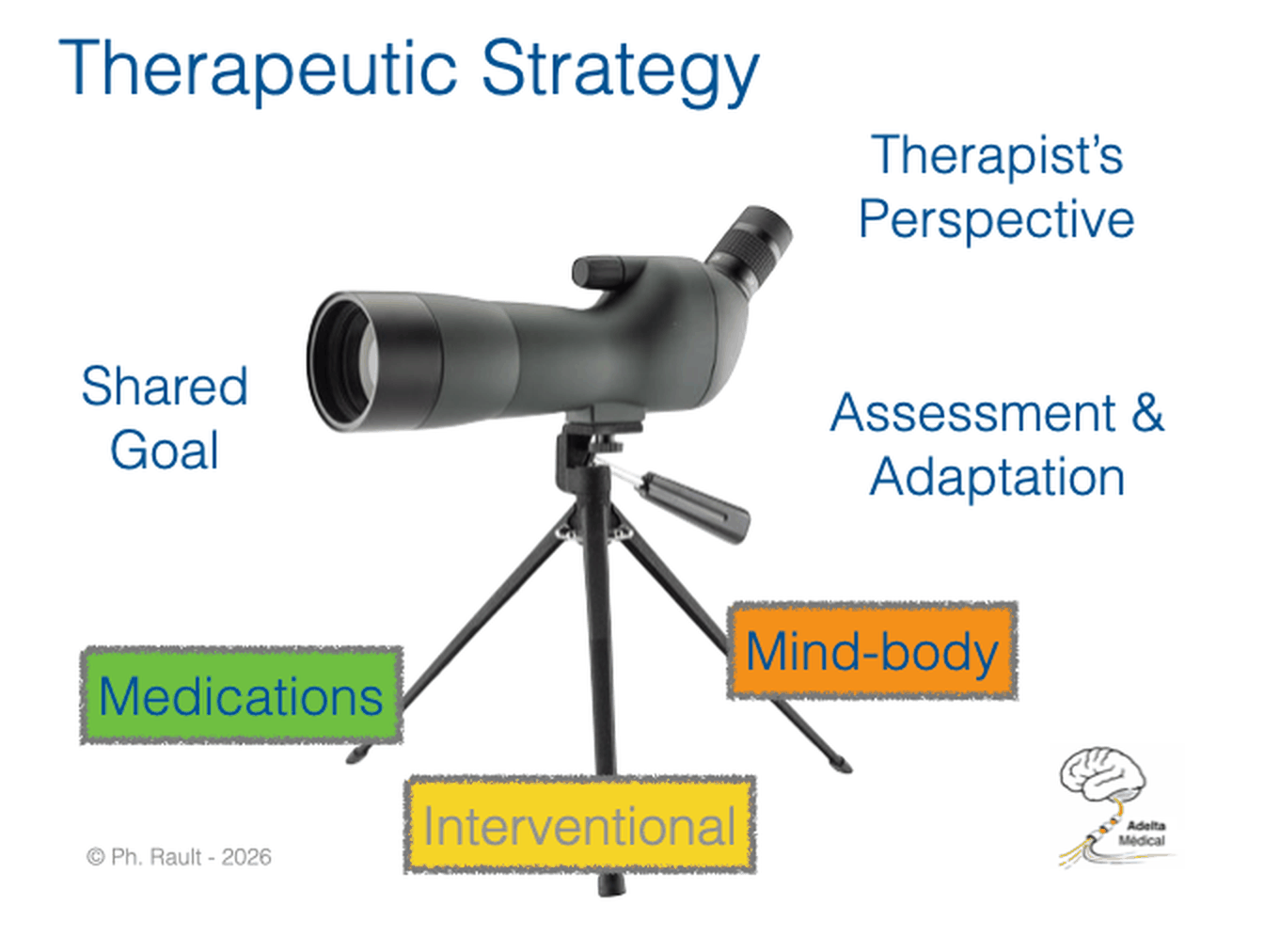
© Philippe Rault, MD, 2026.
1 Medications (chemistry)
Medications are an important part of what we have to offer. However, it must be acknowledged that some patients respond poorly or insufficiently to them. Moreover, there is a growing demand to stop medications, reflecting an ever-stronger societal pursuit of natural approaches.
So yes to medications — but in their rightful place.
2 Interventional techniques (physical)
Whether surgical or not, these techniques are essential and must be combined with medications:
- Injections
- Implantable devices (spinal cord stimulation) or non-implantable (transcutaneous electrical nerve stimulation, TENS)
- Photobiomodulation (low-level laser therapy)
- Direct muscular approach by needling (Dry Needling)
- Ketamine infusion
- Repetitive Transcranial Magnetic Stimulation (rTMS)
3 Mind-body therapies (mental)
3.1 — Psychological focus
All psychotherapy techniques addressing the emotional, cognitive and often behavioural dimensions of persistent pain. Including: therapeutic communication, hypnosis, EMDR, CBT (Cognitive Behavioural Therapy).
3.2 — Physical focus
All physical therapy, osteopathy, and adapted physical activity techniques, with two goals: restoring function in stiffened joints and helping the patient recover from kinesiophobia — the fear of movement that insidiously develops in a suffering body.
2 — The therapeutic strategy: a co-construction
The therapeutic strategy stems from the therapist's perspective of the patient's situation. From there, therapist and patient work toward a shared goal that ensures team cohesion — this is the cement of therapy.
On this stable tripod foundation, patient and therapists co-build the strategy and set up a therapeutic toolbox.
No single leg supports the tripod.
It is their combination that makes the therapeutic strategy stable and effective.